Can NAD+ improve fertility?
Research has not shown that NAD+ therapy improves fertility in humans. NAD+ is being studied because it is tied to cellular energy, repair, and stress-response pathways involved in reproductive health.

purelyIV education · NAD+ support · Reproductive health research
By Erin Boumansour
People are hearing more about NAD+ for energy, aging, and cellular health. So it makes sense to ask a bigger question: does NAD+ have anything to do with reproductive health?
The answer is interesting, and still early. NAD+ helps cells make energy, maintain themselves, and respond to stress. Because eggs, sperm, hormones, and reproductive tissues are all energy-demanding systems, researchers are paying attention.
This article breaks down the science in plain English: why NAD+ and reproductive health are being discussed, what the research may suggest, what it does not prove yet, and how NAD+ IV therapy and Niagen® IV therapy fit into the broader cellular-health conversation.
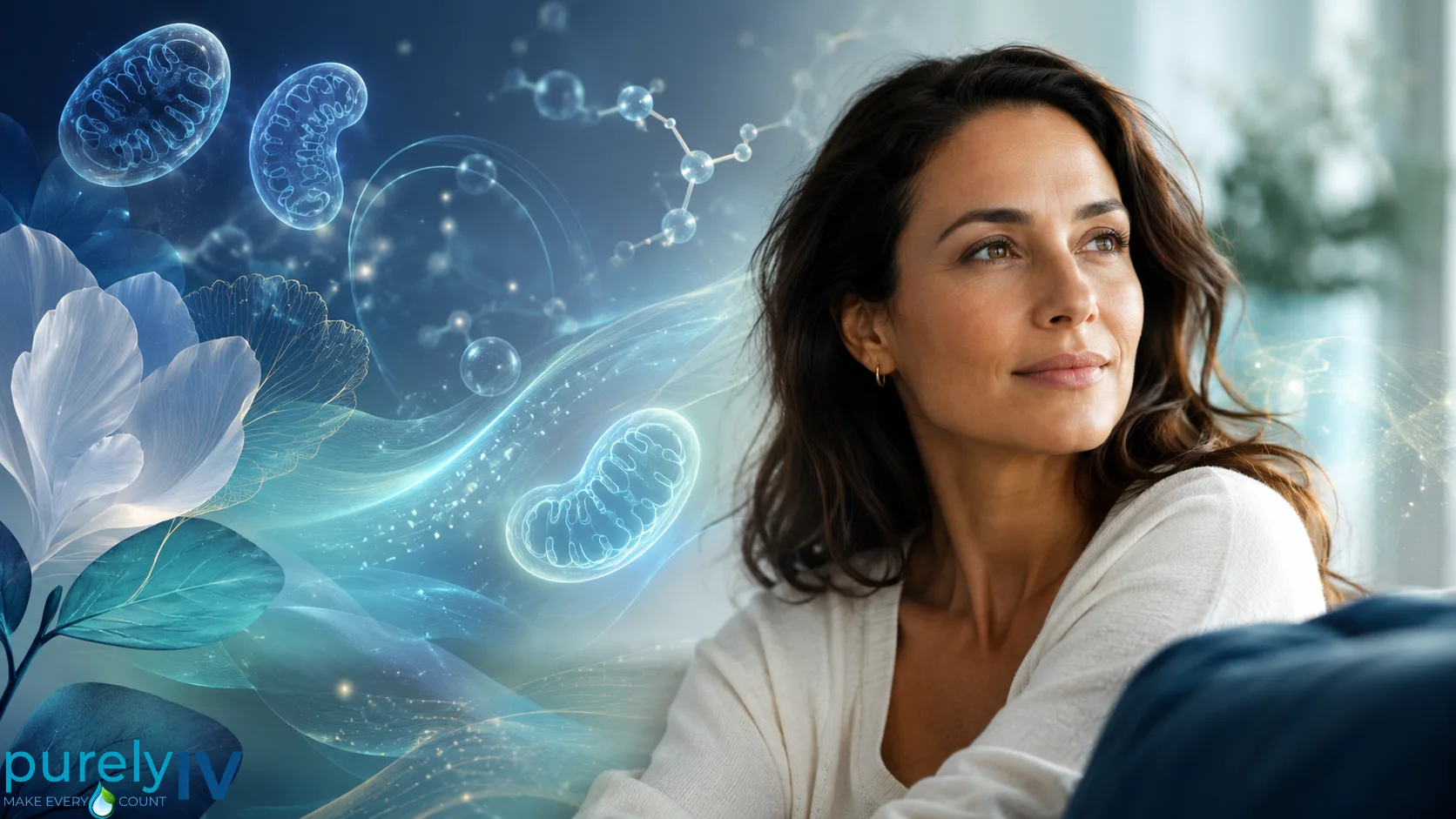
NAD+ stands for nicotinamide adenine dinucleotide. It is a coenzyme, which means it is a helper molecule cells use to carry out important work.
One of its biggest jobs is helping the body turn food into usable cellular energy. NAD+ also supports mitochondria, the parts of the cell that help produce energy, and it is involved in cellular repair, which is the body's normal process of maintaining and repairing cells.
NAD+ also shows up in conversations about oxidative stress. That simply means stress inside cells caused by unstable molecules. When cells are under more stress, their energy and repair systems matter even more.
Reproductive health is not one single process. It includes egg cells, sperm cells, hormone signals, reproductive tissues, early embryo biology, pregnancy biology, and recovery after pregnancy.
Each of those systems depends on cells that need energy and protection from stress. Egg cells, also called oocytes in research papers, are some of the most energy-sensitive cells in the body. Sperm cells also need strong energy systems, especially for movement.
This is where NAD+ becomes interesting. If NAD+ helps cells with energy, repair, and stress response, it makes sense that scientists would want to understand how NAD+ biology connects to reproductive cells and age-related changes in reproductive tissues.
The current conversation is not based on one simple human fertility trial. It comes from several kinds of early research, including lab studies, animal models, embryo and placental models, and reviews that connect NAD+ biology with reproductive-cell aging.
The ChromaDex reproductive-health science summary focuses on preclinical NR research. NR, or nicotinamide riboside, is a NAD+ precursor. A precursor is something the body can use as a building block to make something else.
A recent review on NAD+ and ovarian aging also describes why NAD+ metabolism is relevant to ovarian biology while pointing out that human translation is still uncertain.
The promising part is the logic behind the research. NAD+ sits close to three things reproductive cells care about: energy, repair, and stress response.
Researchers are especially interested in reproductive aging, meaning age-related changes in reproductive cells and tissues. As cells age, their energy systems and repair systems may become less efficient. NAD+ biology may help researchers better understand that process.
That does not make NAD+ a proven reproductive treatment. It does explain why the topic is getting attention and why NAD+ support could become part of future reproductive-health research conversations.
Egg quality research often looks at how well egg cells handle energy, stress, and normal cell division. Mitochondria are a major part of that story because they help produce the energy an egg cell needs to mature.
Sperm health research has a similar energy connection. Sperm movement depends on energy production, and researchers also study oxidative stress and DNA integrity, which means how well the genetic material inside the cell is protected.
These are the kinds of pathways that make NAD+ fertility research interesting. The most responsible way to read the science is not "NAD+ fixes fertility." It is "NAD+ may help scientists understand important cellular systems involved in reproductive health."
These guides explain how NAD+ support is discussed, how Niagen compares, and how purelyIV reviews cellular-health services for adults.
This research is early. Much of it is preclinical, which means it comes from lab work, animal studies, or models that help researchers ask better questions before something is proven in people. Some of the human evidence is observational, meaning it can show connections but not prove cause and effect.
NAD+ support is not a fertility treatment. The current research does not show that NAD+ therapy, Niagen, NR, NMN, or IV therapy improves fertility, changes egg or sperm outcomes, improves IVF outcomes, or changes pregnancy outcomes in humans.
If you are actively trying to conceive, pregnant, breastfeeding, undergoing IVF or fertility treatment, managing PCOS, endometriosis, recurrent pregnancy loss, preeclampsia history, diminished ovarian reserve, male-factor infertility, or another reproductive health concern, work with your physician, OB-GYN, fertility specialist, or qualified clinician before considering NAD+ support.
If you are simply trying to understand why NAD+ is being discussed in reproductive health, the takeaway is encouraging but measured: the biology is relevant, and the science is worth watching.
If you are making real decisions around fertility care, IVF, pregnancy, postpartum recovery, lactation, hormones, or reproductive symptoms, those decisions should stay with the clinician who knows your history and treatment plan.
The most useful next step is to keep NAD+ in the right category: cellular-health support, not reproductive medical care.
purelyIV offers NAD+ IV therapy and Niagen IV therapy for adults interested in cellular health and wellness support after clinical review. These services are not fertility treatments, and they are not positioned as pregnancy, IVF, lactation, or reproductive-disorder care.
NAD+ IV therapy delivers NAD+ during an RN-monitored mobile visit. Niagen IV therapy uses nicotinamide riboside, an NAD+ precursor, and may be of interest to adults looking for NAD+ pathway support through a different wellness option.
Our team can explain available options, review general wellness goals, and help determine whether NAD+ or Niagen belongs in a cellular-health conversation. Reproductive-health decisions should stay with your physician, OB-GYN, or fertility specialist.
If labs, hormone questions, or broader wellness planning are part of your concern, our lab panels, menopause care, and IV services pages can provide helpful context.
Research has not shown that NAD+ therapy improves fertility in humans. NAD+ is being studied because it is tied to cellular energy, repair, and stress-response pathways involved in reproductive health.
Anyone trying to conceive or undergoing fertility care should talk with their OB-GYN, fertility specialist, or qualified clinician before starting NAD+ support, Niagen, NR, NMN, or IV therapy.
NAD+ IV therapy delivers NAD+ during an RN-monitored IV visit, while Niagen IV therapy uses nicotinamide riboside, an NAD+ precursor. Both are reviewed as cellular-health services for eligible adults.
Yes, purelyIV offers NAD+ and Niagen options for eligible adults after clinical review. These services support cellular-health conversations and are not reproductive medical treatment.
NAD+ is relevant to reproductive-health research because reproductive cells depend on energy production, mitochondrial function, stress response, and normal cellular repair.
The research is promising, early, and worth watching. For now, NAD+ support should be viewed as cellular-health support for eligible adults after appropriate review, not as fertility care or a promise of reproductive outcomes.
If you are an eligible adult comparing cellular-health services, our team can explain NAD+ IV therapy, Niagen IV therapy, and when a different clinical starting point makes more sense.
Disclaimer: The information in this blog post is for informational purposes only. It is not a substitute for professional medical advice, diagnosis, or treatment. Always seek the guidance of a qualified health professional with any questions you may have regarding a medical condition.